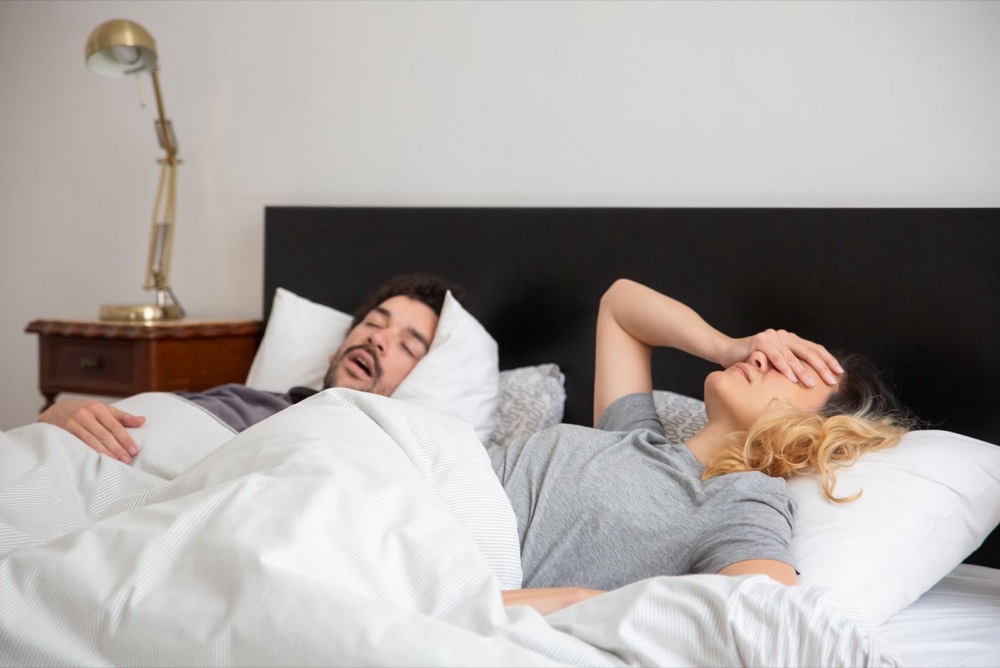
You see your dentist twice a year — often more regularly than any other health provider. That puts us in an unusual position to notice the signs of a breathing problem that shows up in the mouth long before it gets diagnosed.
In obstructive sleep apnea (OSA), the soft tissues at the back of the throat relax during sleep and repeatedly narrow or block the airway. Breathing pauses, blood oxygen drops, and the brain briefly rouses you just enough to reopen the airway. This can happen dozens of times an hour.
Because those arousals are too brief to remember, most people have no sense that their sleep is fragmented. They simply know they wake up tired no matter how many hours they spent in bed.
Several findings we routinely see during an exam are associated with airway problems. None of them is proof of anything on its own, but together they justify a conversation:
This distinction matters, so we want to be direct about it. A dentist cannot diagnose sleep apnea. Diagnosis requires a sleep study — either an in-laboratory polysomnogram or an approved home sleep apnea test — interpreted by a qualified physician.
What we do is screen. If your exam and history suggest a risk, we discuss it with you and coordinate a referral. Treatment decisions, including whether an oral appliance is appropriate for you, follow the diagnosis rather than precede it.
An oral appliance for sleep apnea is usually a mandibular advancement device. It looks somewhat like two thin retainers joined together, and it holds your lower jaw in a slightly forward position while you sleep. That forward position helps keep the airway from collapsing.
Professional guidelines from the American Academy of Sleep Medicine and the American Academy of Dental Sleep Medicine support oral appliance therapy for adults with primary snoring, and for adults with obstructive sleep apnea who cannot tolerate CPAP or who prefer an alternative to it. For severe OSA, CPAP remains the first-line therapy, and that decision belongs to your physician.
After a physician has diagnosed you and an oral appliance has been determined appropriate, we take a digital scan or impressions and record how your jaw relates in a forward position. The appliance is fabricated to those records and fitted in the office.
From there it is titrated — advanced in very small increments over several weeks — until symptoms improve and you remain comfortable. Your physician will typically arrange a follow-up sleep test with the appliance in place to confirm it is actually working, which is a step worth insisting on.
Side effects are usually mild and often temporary: jaw soreness in the morning, extra saliva or a dry mouth, and some tooth tenderness. Over the longer term, small changes to the bite can occur, which is one reason we monitor the fit at every checkup.
Beyond the exhaustion, untreated obstructive sleep apnea is associated with high blood pressure, cardiovascular disease, type 2 diabetes, and a higher risk of motor vehicle accidents from daytime sleepiness. It is also associated with acid reflux and with the tooth wear we so often see.
If any of this sounds familiar — for you or for the person sleeping next to you — bring it up at your next visit. It costs nothing to ask, and it is a short conversation that occasionally changes someone’s health considerably.
A dentist cannot diagnose sleep apnea — only a physician can, based on a sleep study. What we can do is recognize the signs, get you referred, and build the custom oral appliance that many diagnosed patients use instead of, or alongside, CPAP.
Not for sleep apnea. A diagnosis from a physician, based on a sleep study, is required before oral appliance therapy for OSA. Appliances for simple snoring without apnea are a different conversation, but we still want apnea ruled out first — treating the snoring while leaving apnea untreated is a real risk.
CPAP is generally more effective at reducing apnea events, and it remains first-line for severe OSA. However, an appliance that a patient wears every night can outperform a CPAP that sits unused in a closet. Adherence matters, which is why guidelines support appliances for patients who cannot tolerate CPAP.
Small bite changes can develop over years of use. We take baseline records, check your bite at every visit, and can often manage minor shifts with morning repositioning exercises. This is a trade-off worth discussing openly against the health risks of untreated apnea.
Oral appliance therapy for diagnosed OSA is often billed to medical insurance rather than dental. Coverage varies, and documentation of the diagnosis is required. We can help you understand what your plan requires.
This article is for general education and is not a substitute for an in-person evaluation. Every mouth is different — schedule an exam with Dr. Constandelis to discuss what's right for you.
Written by Dr. Dena Constandelis, DMD
Dr. Constandelis received her DMD from the University of Medicine and Dentistry of New Jersey (now Rutgers School of Dental Medicine) and practices in her hometown of Clifton, NJ, where she took over her father's practice.

Every other Fri & Sat
9:00am - 2:00pm

