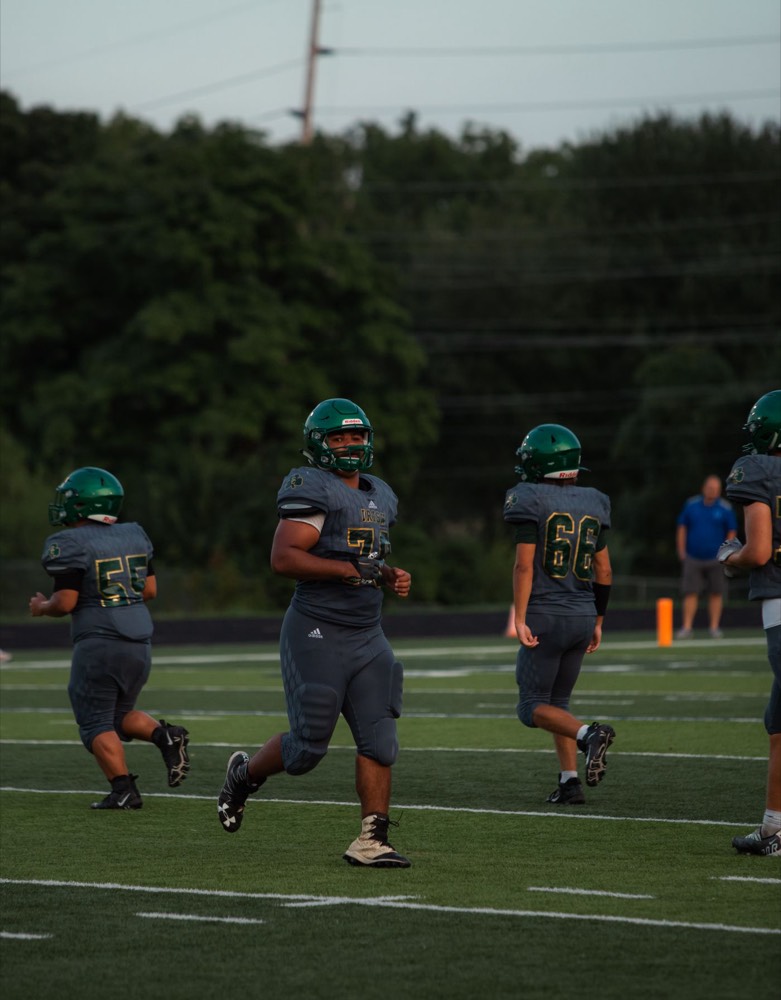
Every season we see the same injury: a young athlete, a collision or a stray elbow, and a fractured or knocked-out front tooth. It is one of the most preventable injuries in youth sports, and the prevention costs a fraction of the repair.
New Jersey high school athletics follow the playing rules of the National Federation of State High School Associations. The NFHS mandates mouthguards in football, field hockey, ice hockey, and lacrosse, and requires them in wrestling for athletes wearing fixed orthodontic appliances.
Notice what is missing from that list: basketball, soccer, baseball, and softball. Those sports are not required to use mouthguards, yet basketball and baseball are associated with a large share of sports-related dental injuries. Requirement and risk are not the same thing, and the American Dental Association recommends a mouthguard for a much broader range of activities than the ones that mandate it.
The American Dental Association estimates that athletes who do not wear a mouthguard are roughly 60 times more likely to sustain damage to their teeth than those who do, and that more than 2 million teeth are knocked out each year in sports-related incidents.
One clarification worth making, because it is commonly misstated: current research does not support the claim that mouthguards reduce the risk or severity of concussion. The NFHS is explicit about this. A mouthguard is dental protection, and that alone is reason enough to wear one.
Stock guards come preformed in a package. They are the cheapest option and the worst-fitting; because they cannot be adjusted, athletes tend to clench to hold them in place and often end up not wearing them at all.
Boil-and-bite guards soften in hot water and are shaped by biting down. They fit better than stock guards and are a reasonable stopgap. Their weakness is that the material thins out precisely where the bite pressure is greatest — over the front teeth you are trying to protect — and they loosen as the material relaxes.
Custom guards are fabricated from a scan or impression of your athlete’s own teeth. The thickness is controlled and consistent across the arch, retention comes from fit rather than clenching, and they interfere far less with breathing and speech. That last point drives the outcome that matters most: athletes wear them.
An athlete in fixed braces needs a guard designed around the brackets, with enough room to accommodate them and enough resilience to protect the lips and cheeks from being lacerated against the hardware during impact. A standard boil-and-bite is a poor choice here, and can even lock onto the appliance.
For wrestling specifically, NFHS rules require that a guard worn by an athlete with fixed appliances cover both the upper and lower appliances.
Rinse it with cool water before and after each use, and brush it occasionally with a toothbrush. Store it in a ventilated case so it dries out — a sealed bag grows bacteria. Keep it out of a hot car or direct sun, because heat will warp the fit permanently. Bring it to checkups so we can inspect it.
For growing children and teenagers, plan on a new guard each season. Their jaws and erupting teeth change enough over a year that last season’s guard often no longer seats correctly.
This is a true dental emergency and the first hour matters enormously. Handle the tooth by the crown — the chewing part — and never by the root. If it is dirty, rinse it gently with milk or saline for a few seconds; do not scrub it and do not remove any attached tissue.
If you can, place the tooth back into its socket and have the athlete bite gently on clean gauze to hold it. If reimplanting is not possible, transport it in milk, in saline, or in the athlete’s own saliva — not in plain water, which damages the root cells. Then get to a dentist immediately. Reimplantation within the first 30 to 60 minutes gives the best chance of saving the tooth. Call us at (973) 684-1078 on the way.
A knocked-out permanent front tooth is a lifetime of dental work. A custom mouthguard is one appointment. The guards that get worn consistently are the ones that fit properly and feel comfortable.
A custom guard is a single, modest, one-time cost. Restoring a fractured front tooth may involve bonding, a crown, root canal treatment, or an implant, and often needs to be redone over a lifetime. The economics are not close.
An upper guard is standard for most sports and satisfies governing-body requirements, since the upper front teeth take the majority of impacts. Athletes with certain bites or with lower fixed appliances may need lower coverage as well; we assess that individually.
That is almost always a fit problem, and it is the main reason guards end up on the bench instead of in the mouth. A properly made custom guard is trimmed and contoured so it does not interfere with breathing or speech. Bring it in and we will adjust it.
Give yourself a couple of weeks before the first practice. That leaves time to fabricate the guard and make any adjustments so it is comfortable from day one.
This article is for general education and is not a substitute for an in-person evaluation. Every mouth is different — schedule an exam with Dr. Constandelis to discuss what's right for you.
Written by Dr. Dena Constandelis, DMD
Dr. Constandelis received her DMD from the University of Medicine and Dentistry of New Jersey (now Rutgers School of Dental Medicine) and practices in her hometown of Clifton, NJ, where she took over her father's practice.

Every other Fri & Sat
9:00am - 2:00pm

